The Overnight Jug: Cold-Brewed Green Tea, No Kettle Required
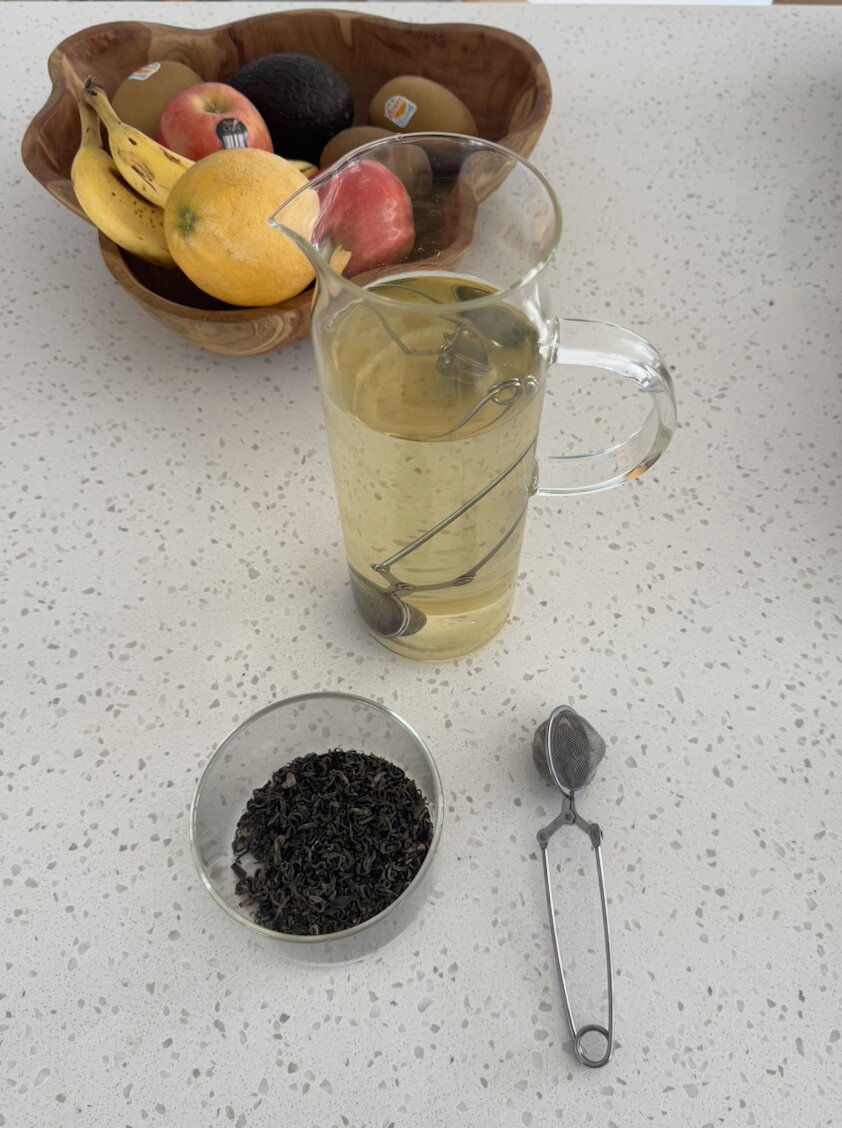
The whole operation: leaves, steel, glass. Nothing else touches the water.
Every number in the tea bag post had the same accomplice: heat. McGill’s 11.6 billion particles came off tea bags steeped at 95 °C. The University of Queensland’s kettles shed hardest on their first boils. Even the “compostable” PLA cup released its particles into hot coffee, not cold. Plastic sheds when you heat it — that’s the mechanism running through this entire site.
So here is the logical end point of plastic-free tea, arriving just in time for the warm months: take the plastic out of the brew, then take the heat out as well.
The whole rig was already in the kit
Three items, all on the kit page, all bought for ordinary hot brewing long before I realised they had a second career:
- A 2 L glass fridge pitcher — A$24.50, and as it happens the very first thing I bought when this project started in January 2025.
- Stainless steel snap-ball infusers — A$18.99 for three. If you’ve ever wondered what the little mesh ball on the spring-loaded scissor handle is actually called: it’s a snap-ball tea infuser. Squeeze, it opens; let go, it snaps shut around the leaves.
- Loose-leaf green tea — a Himalayan green (A$18.99) or a Kyoto sencha (A$19.99), both replacing tea bags that were most likely sealed with polypropylene.
Call it A$62 of hardware. Marginal cost of the cold-brew habit: zero.
The method, such as it is
In the evening: fill one snap-ball loosely with leaves — about a heaped tablespoon; they need room to unfurl — drop it into the jug, top up with two litres of cold filtered tap water, and put the jug in the fridge. Go to bed. That is the entire technique.
Eight to twelve hours later, lift the ball out, rinse it under the tap, done. The jug keeps for a couple of days in the fridge, though mine has never once been asked to.
To serve: a glass, ice cubes, a sprig of fresh peppermint, and a squeeze of lemon — added to the glass at serving time, never to the jug. Field note from repeated self-inflicted experiments: lemon that sits in the jug for hours turns the whole batch bitter. Lemon that lands in the glass thirty seconds before you drink it keeps everything bright. (There’s also a proper scientific reason to add it at all — below.)
What cold water actually does differently
The claim you’ll hear is “cold brew has more nutrients.” The evidence says something more specific, and more interesting: cold water doesn’t brew a weaker version of hot tea — it brews a different drink.
It leaves most of the caffeine in the leaf. Japan’s national agricultural research organisation, which takes green tea about as seriously as any institution on earth, measured it: brewed at 10 °C, green tea gives up roughly half the caffeine of a hot brew, and with near-freezing water the infusion carries under 20 % of hot-brew caffeine (Monobe, JARQ 2018) lab. A two-litre jug you can drink all afternoon without buzzing.
It leaves the bitterness behind too. The two great bitter-astringent players in green tea — caffeine and the catechin EGCG — are both reluctant cold-water swimmers: EGCG came across at only ~20 % in that same short cold steep. Meanwhile the sweet-umami amino acids, theanine chief among them, extract at ~80 % lab. Less of the harsh, most of the sweet — that’s the entire flavour profile of cold brew explained in one extraction table, and the reason this drink needs no sugar.
Given time, the good stuff catches up. Those numbers are for a one-hour cold steep. Leave the jug overnight and the gap closes: a team that brewed the same teas both ways — five minutes near-boiling against sixteen hours cold — found hot brews often ahead on total polyphenols, but “in the majority of cases, no statistical differences” between the two methods (Damiani et al., Antioxidants 2023) lab. Overnight patience buys a hot brew’s antioxidant load at fridge temperature.
And heat isn’t free. Near boiling, a measurable share of EGCG flips into its epimer GCG — a rearranged molecule the health literature knows far less about (Wang & Helliwell, Food Chemistry 2000) lab — and heat-fragile passengers like vitamin C degrade. Cold water never asks the molecules to survive anything.
The Japanese case for cold brew as its own drink. The NARO researchers push one step further: two of green tea’s most interesting compounds — EGC (studied for immune effects) and theanine (studied for stress reduction) — appear to be inhibited by EGCG and caffeine. Their conclusion, in nearly as many words: to get what EGC and theanine offer, brew cold (Monobe, JARQ 2018) early.
Honesty box: everything above is brew chemistry — measurements of the drink, not of the drinker. Nobody has run a trial following cold-brew versus hot-brew tea drinkers to health outcomes, and I won’t pretend otherwise. What the chemistry supports is narrower and still worth having: fewer of the compounds that make tea harsh, comparable polyphenols if you give it the night, and none of the losses that come with heat.
The lemon goes in the glass — and there’s a paper about it
The squeeze of lemon isn’t just for taste. Catechins are famously fragile in digestion: in Purdue University’s simulated gut, less than 20 % of green tea’s catechins survived intact. Add lemon juice and about 80 % remained; plain vitamin C multiplied recovery of the two most abundant catechins six- and thirteen-fold (Purdue University, published in Molecular Nutrition and Food Research, 2007) lab. An in-vitro model, not a human trial — but it costs one lemon wedge to act on, and the drink tastes better anyway.
So: lemon yes, lemon late. Squeezed at serving time you get the brightness and the ascorbic acid; left in the jug overnight you get citrus’s slow-developing bitterness spread through two litres of otherwise perfect tea.
Where the plastic comes into it
Run the tally on this jug. The water came through a glass-and-steel filter carafe. It never met a kettle, plastic or otherwise. The leaves never sat in a polypropylene-sealed bag, because there is no bag. The brewing vessel is glass, the infuser is stainless steel, and the whole process happens at 4 °C — below every temperature at which the shedding studies get their alarming numbers, in a system with nothing to shed in the first place.
Full honesty: my hot-tea setup was already plastic-free, so the marginal plastic avoided here is roughly zero. The real wins are quieter. It’s the best green tea I’ve made. It replaced the cold drinks that do come in plastic — soft drink, bottled iced tea; bottled water alone carries ~240,000 particles per litre. And it costs cents a litre.
Spring starts tomorrow. The jug is already full.
Part of the series on getting plastic out of my body — the tea story starts with what’s in your tea bag, and the full gear list with receipts lives on the kit page.
Sources
- Health functions of compounds extracted in cold-water brewed green tea — Monobe, JARQ 52(1), 2018 (PDF) — extraction rates at 10 °C vs 80 °C (caffeine ~50 %, EGCG ~20 %, EGC ~70 %, amino acids ~80 %; near-freezing water under 20 % caffeine), and the EGC/theanine case for cold brewing
- Comparative analysis of hot and cold brews from single-estate teas — Damiani et al., Antioxidants 12(6):1306, 2023 — 16-hour cold brews vs 5-minute hot brews: total polyphenols and antioxidant activity mostly statistically indistinguishable
- Epimerisation of catechins in green tea infusions — Wang & Helliwell, Food Chemistry 70(3), 2000 — EGCG converts to its epimer GCG at brewing temperatures
- Citrus juice and vitamin C give staying power to green tea antioxidants — Purdue University news, 2007 · ScienceDaily summary — published in Molecular Nutrition and Food Research
- Heat-driven particle shedding, covered previously on this site: McGill teabags at 95 °C · UQ kettles · bottled water, PNAS 2024